
Tishk International University
Academic Catalog 2025–2026
Contents
- About TIU
- Academic Calendar
- Admission Requirements
- Academic Regulations
- Credit System
- Grading System
- Graduation Requirements
- Educational System
- Undergraduate Programs
- Master Programs
- Program Curricula
- Course Descriptions
- Internship
- Graduation Project Requirements
- Expected Duration of Study
- Academic Policies
- Student Services and Academic Resources
1. About TIU
2. Academic Calendar
The official academic calendar lists semester start and end dates, registration periods, examination weeks and official holidays.
3. Admission Requirements
[Insert content from Doc 3]4. Academic Regulations
Academic regulations covering attendance, examinations, registration and student conduct are published in the Student Handbook.
5. Credit System
TIU uses ECTS Credit System in all the departments, then, What is ECTS Credit ?
ECTS stands for European Credit Transfer and Accumulation System. It’s a way to measure how much work a student does for a course.
Benefits for Students:
- It makes it easier to transfer your credits if you study at a different university, even in another country.
- You can clearly see how much work each course requires and plan your study time better.
- It helps universities recognize your completed courses and count them toward your degree, making studying abroad or switching programs simpler.
Example: If you complete 30 ECTS credits in one semester abroad, your home university will accept those credits toward your degree.
ECTS Credit System at Tishk International University
Tishk International University (TIU) applies the European Credit Transfer and Accumulation System (ECTS) across all academic departments. The ECTS system provides a clear and standardized way to measure the total workload required from students to successfully complete a course, semester, academic year, and degree program.
What is ECTS Credit?
ECTS stands for European Credit Transfer and Accumulation System.
It is a student-centered credit system used to measure the amount of work a student is expected to complete in order to achieve the learning outcomes of a course or academic program.
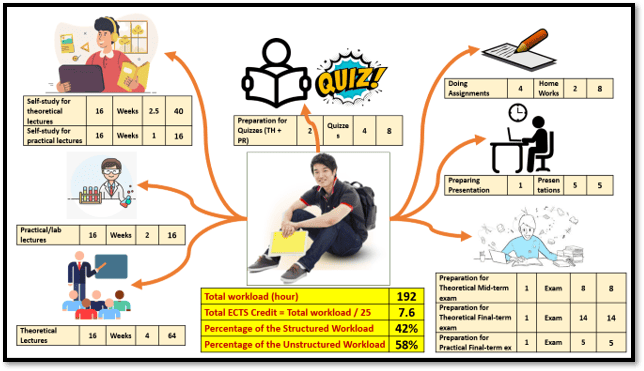
ECTS credits do not represent only classroom or lecture hours. They reflect the student’s total academic workload, which may include:
- Lectures and classroom activities
- Laboratory and practical work
- Assignments and homework
- Projects and presentations
- Quizzes and examinations
- Independent study and reading
- Preparation for assessments
- Other academic activities related to the course
At TIU, the workload is calculated as follows:
1 ECTS Credit = 25 hours of student workload
Accordingly:
- 1 academic term = 30 ECTS credits = 750 workload hours
- 1 academic year = 60 ECTS credits = 1,500 workload hours
- A Bachelor’s degree program = 240 ECTS credits = 6,000 workload hours
This means that a typical four-year Bachelor’s degree program at TIU consists of 240 ECTS credits, with 60 ECTS credits completed during each academic year.
Why Does TIU Use the ECTS System?
Using ECTS helps TIU organize its academic programs in a transparent and internationally understandable format. It allows students to clearly understand the workload associated with each course and supports consistency in curriculum planning across departments.
The system also helps describe academic achievement in a format commonly used in European higher education, making it easier to understand and compare study loads between institutions and academic programs.
How Are ECTS Credits Awarded?
Students receive the ECTS credits assigned to a course after successfully completing the required academic activities and assessments and achieving the intended learning outcomes of that course.
Therefore, ECTS credits reflect not only the time spent attending classes but the overall effort required from the student to successfully complete the course.
ECTS Workload at a Glance
| Academic Load | ECTS Credits | Student Workload |
|---|---|---|
| 1 ECTS Credit | 1 | 25 hours |
| 1 Academic Term | 30 | 750 hours |
| 1 Academic Year | 60 | 1,500 hours |
| Bachelor’s Program | 240 | 6,000 hours |
Through the implementation of the ECTS Credit System across all departments, Tishk International University ensures a consistent, transparent, and student-centered approach to measuring academic workload and progress.
6. Grading System
Grading System at Tishk International University
Tishk International University uses a letter grading system to evaluate students’ academic achievement. For each course taken, students are awarded a letter grade by the course lecturer as the final grade of achievement for that course. Tishk International University
Grade Scale
| Letter Grade | Grade Point (out of 4.00) | Grade Equivalent (out of 100) |
|---|---|---|
| AA | 4.00 | 90–100 |
| BA | 3.50 | 85–89 |
| BB | 3.00 | 80–84 |
| CB | 2.50 | 75–79 |
| CC | 2.00 | 70–74 |
| DC | 1.50 | 60–69 |
| DD | 1.00 | 50–59 |
| FD | 0.50 | 40–49 |
| FF | 0.00 | 0–39 |
These letter grades and their numerical equivalents are used in calculating students’ Semester Point Average (SPA) and cumulative Grade Point Average (GPA).
Course Assessment
The final grade of a course includes all academic work completed during the semester, such as:
- Mid-term examinations
- Quizzes
- Field studies
- Practical activities
- Assignments
- Projects
- Workshops and seminars
- Attendance
- Laboratory studies
- Final examination
According to the TIU Student Handbook, examinations and other evaluation criteria during the semester account for 60% of the overall course grade, while the final examination accounts for 40%. The lecturer announces the achievement evaluation system for each course within one week following the beginning of the semester.
Special Rule for Dentistry and Pharmacy
For students in the Faculties of Dentistry and Pharmacy, a student must obtain at least 60 out of 100 in the final examination in order to pass the course. If the student receives less than 60 in the final examination, the result is FF, regardless of the marks obtained from other examinations or evaluation activities.
Passing and Failing Grades
A student with a Grade Point Average of 2.00 or above, and without a failing grade in the academic program, is considered to have satisfactory academic standing.
A student is considered to have successfully passed a course when receiving:
S, EX, CC, or a grade higher than CC.
Grades FF, FD, U, and NA are considered unsuccessful, and the student must repeat the course.
DC and DD Grades
The status of DC and DD grades depends on the student’s Semester Point Average:
- If the Semester PA is 2.00 or above, DC and DD are accepted as passing grades and are shown as DC+ and DD+.
- If the Semester PA is below 2.00, DC and DD are considered failing grades and are shown as DC− and DD−.
For the Faculties of Dentistry and Pharmacy, DC and DD are considered failing grades regardless of the Semester PA.
Grades Not Included in the Average
The following grades may also appear on a student’s academic record but are not treated as regular numerical letter grades:
| Grade | Meaning |
|---|---|
| S | Satisfactory |
| U | Unsatisfactory |
| P | Progressive |
| EX | Exempt |
| NI | Not Included |
| NA | Non-Attendant |
| T | Transfer |
| I | Incomplete |
The NA grade is given when a student fails to fulfill the attendance requirements of a course or its applications and is treated as FF when calculating the GPA. The EX grade is awarded to students who successfully pass an approved exemption examination and is not included in GPA calculations.
An Incomplete (I) grade may be given when a student has been successful during the semester but cannot complete the course requirements because of illness or another valid reason. Normally, the student must complete the missing requirements within 15 days from the announcement of grades; otherwise, the I grade automatically becomes FF, unless an extension is formally approved.
Semester Point Average and GPA
The Semester Point Average (SPA) is calculated by multiplying the numerical grade obtained in each course by the number of credits assigned to that course and dividing the total by the number of credit hours studied during the semester.
The Grade Point Average (GPA) is calculated in the same manner across the courses included in the student’s academic program.
Academic Achievement
Students who successfully complete all courses in a semester and achieve an SPA between 3.50 and 4.00 are placed on the High Honors List, except during the summer term.
For graduation, students must successfully complete all courses in their academic program and achieve a GPA of at least 2.00, in addition to fulfilling the other graduation requirements determined by the University.
7. Graduation Requirements
Graduation Requirements
To be eligible for graduation from Tishk International University (TIU), undergraduate students must successfully complete all academic requirements of their program and satisfy the graduation conditions approved by the University.
Students are required to:
- Successfully pass all courses included in the curriculum of their academic program.
- Achieve a cumulative Grade Point Average (GPA) of at least 2.00.
- Successfully complete the required number of ECTS credits:
- 240 ECTS credits for undergraduate programs in general.
- 300 ECTS credits for Dentistry, Pharmacy, and Architecture Engineering.
- Successfully complete the required internship program, with a minimum duration of six weeks.
- Successfully complete the Graduation Project or other final project requirements specified by the relevant academic program.
- Fulfill any additional graduation requirements determined by the relevant faculty, department, and University regulations.
- Be formally deemed to have fulfilled the graduation requirements by the decision of the relevant academic board.
Students who successfully meet all graduation requirements are awarded an undergraduate diploma indicating the faculty and, where applicable, the department or academic program.
Before the diploma is issued, graduating students must also complete the required university clearance procedures with the relevant University units.
Graduation Make-up Examination
Graduating students who do not have U or NA grades—excluding internship—but have failed a maximum of two courses with grades FF, FD, DD, or DC, may be eligible to take a Graduation Make-up Examination in accordance with University regulations.
The Graduation Make-up Examination is subject to the following conditions:
-
- It may be taken for a maximum of two failed courses.
- The highest grade that may be awarded is CC.
- The examination is held on dates determined by the relevant academic department.
- Where permitted by the University regulations, students may repeat the Graduation Make-up Examination after retaking the relevant course.
8. Educational System

TIU implements the European educational system (bologna process)
Tishk International University implements the European educational system through the Bologna Process, which standardizes higher education across Europe. This system promotes student mobility, credit transfer (ECTS), and quality assurance. It ensures that TIU’s degrees are compatible and recognized internationally.
9. Undergraduate Programs
Please put the most updated list
10. Master Programs
Please put the most updated list
11. Program Curricula
Please put the list of our departments in a clickable button to view/download the curriculum table from wither e-link from the department page or downloadable pdf.
12. Course Descriptions
Please put the list of our departments in a clickable button to view/download the course descriptions from wither e-link from the department page or downloadable pdf.
13. Internship
Internship Program:
To further improve the relationship between our students and the industry, the University established an internship program that is compulsory for every bachelor’s degree student in the university. This program helps the students to gain hands-on experience with market and service providers. The following points describe the general process of holding and administrating the internship programs at TIU.
Internship Program Process at TIU
- The Academic Department conducts an orientation session prior to the start of the internship Program.
- The student looks for an internship opportunity
- The student finds an internship opportunity
- The student gets the “Internship Application Form” from his/her Department Internship Supervisor. The student and the supervisor should define the “Learning Objectives” of the particular Internship experience.
- The student obtains the Host Organization Approval on the “Internship Application Form”, then s/he submits it to his/her Department Internship Supervisor.
- The student obtains the “Internship Job Description” from the Host Organization (either a ready one or by filling the “Template of Job Description”. The Student attaches the description to the application form.
- The Department Internship Supervisor approves the submitted “Internship Application Form”.
- The student attends the Internship Program.
- The student must submit administrative log that proves the hours the student has worked.
- The Department Internship Supervisor schedules several contact points with the student during the internship to monitor progress of the internship, student’s progress in reaching the learning objectives and to assure completion of all assignments.
- The student delivers the “Internship Evaluation Form” to the Host Organization.
- The Host Organization Supervisor fills out the evaluation form and submits it directly to TIU Department. If it was sent with the trainee, it should be put inside a sealed, signed, and stamped envelope.
- The Department Internship Supervisor approves the submitted Evaluation Form.
- The student prepares the “Internship Final Report” of min 4 pages and max of 6 pages according to the ISO form.
- After completion, the materials shall be forwarded to the head of department for approval and to forward it to departmental committees for grading.
14. Graduation Project Requirements
Graduation Project
At Tishk International University, compulsory graduation studies may include a thesis, project, seminar, internship, research, fieldwork, elective courses, or other academic activities that demonstrate that students have reached the required professional level according to their educational program.
The requirements for graduation studies, including their submission, examination, and evaluation, are determined by the authorized committee of the relevant department or academic program. Graduation studies are generally scheduled within the last two semesters of the program, although a graduation study may also be included within a single course. Topics may be assigned to students in earlier years according to the applicable regulations.
Graduation Project Evaluation
The Graduation Project evaluation consists of three main components:
- Academic Level of the Thesis/Project
- Progress Evaluation
- Presentation and Defense
Passing the Presentation and Defense Session is a mandatory condition for passing the Graduation Project course. A student who does not pass the Presentation and Defense Session is considered to have failed the course.
Evaluation Criteria
The academic level of the Graduation Project may be evaluated according to criteria including:
- Project or research aims
- Academic level of the literature review
- Project or research methodology
- Practical work or data collection
- Analysis of results
- Conclusions and recommendations
- Academic quality of references
The student’s progress may also be evaluated based on:
- Commitment to meetings
- Teamwork, where applicable
- Responsiveness
- Academic ethics
The Presentation and Defense is evaluated according to:
- Quality of the presentation
- Ability to communicate and deliver ideas
- Ability to answer questions
Departments may use equivalent criteria and may add further criteria where appropriate.
Plagiarism and Academic Integrity
A plagiarism test must be conducted before the defense. The acceptable similarity percentage is determined and benchmarked by the scientific committee of the relevant department.
It is recommended to conduct the plagiarism check approximately two weeks before the final submission deadline, allowing students sufficient time to reduce the similarity percentage if it exceeds the permitted level. The project supervisor is responsible for reviewing the plagiarism report and assessing the identified areas of similarity.
Evaluation Rubric and Feedback
The evaluation criteria and performance levels must be clearly stated in the project’s evaluation form, rubric, or thesis manual and should be shared with students during the early stages of the project.
Suggested corrections and recommendations resulting from the evaluation should be provided to students in written form.
Group Graduation Projects
Where a Graduation Project is completed by a group of students, a significant part of the final grade must be based on individual assessment.
Individual performance must be assessed during both the Progress Evaluation and the Presentation and Defense Evaluation. The handbook specifically states that purely collective scoring is not acceptable.
Graduation Project Examination
The Graduation Project examination is conducted during the final examination period.
The followings are the steps of the Graduation Project Process at TIU:
- The Head of the Department directs each lecturer to propose a minimum of three research directions or subtopics that align with his/her research interests and area of expertise.
- The student, in consultation with academic advisors, selects a relevant and feasible topic for the graduation project. The topic should align with the student’s academic interests and the guidelines provided by the department.
- The student is assigned a project supervisor by the Departmental Scientific Committee based on the research directions indicated by the lecturers in step 1.
- The supervisor assists in refining the project scope, defining objectives, and setting milestones.
- The Head of Department announces the titles of the projects on TIU official platforms: PIS/SIS, Webpage, Lecture notes
- The supervisor and the students sign the “Graduation Project Supervision Agreement”
- The Department fills in the “4/5th Year Supervision List” and announces it to students n TIU official platforms: PIS/SIS, Webpage, Lecture notes.
- Graduation Research Project Committee is established in the department with supervisors to be the members. The Head of Department assigns one of the members to be the Graduation Research Projects Committee Chair.
- The Graduation Research Projects Chair arranges seminars for the 4TH/5TH Grade Students about how to conduct and write the graduation project to tackle the most crucial topics related to the research project and to demonstrate the Graduation Research Project Manual.
- The student meets regularly with the project supervisor (minimum twice a month) for updates and feedback. The supervisor provides guidance, addresses challenges, and monitors the overall progress of the project. The supervisor documents the meetings using “Supervision Log and Progress Sheet.”
- By the end of the academic year, the department prepares a list of GP Defense Committees for all the projects.
- As the project progresses, the student begins preparing the thesis document. The thesis includes sections such as introduction, literature review, methodology, results, discussion, and conclusion.
- The student submits the draft thesis to the GP Defense Committee for review. The committee evaluates the quality of research, methodology, and adherence to academic standards.
- The student incorporates feedback from the GP Defense Committee and revises the thesis accordingly. The final version of the thesis is prepared for submission.
- The student defends the thesis in front of GP Defense Committee. The defense includes a presentation of key findings, methodology, and responses to questions from the committee.
- The GP Defense Committee evaluates the thesis and defense performance. The student is graded based on the quality of the research, adherence to academic standards, and the effectiveness of the defense.
15. Expected Duration of Study
| 4-Year Programs | 5-Year Programs |
|---|---|
| [Program name] | [Program name] |
| [Program name] | [Program name] |
Source: Student Affairs.
16. Academic Policies
The latest Student Handbook and university policies are available on the Student Handbook page.
17. Student Services and Academic Resources
Academic Advising
TIU implements an integrated and systematic Academic Advising service to support students in successfully completing their studies at the university. At the beginning of the academic year, the Head of department assigns advisors for each study year. The advisor creates a schedule to meet students of the designated study year. During the advisory session the advisors discusses the below checklist with the student then reports the feedback to the Head of Department in case of need.
| Important policies in the Students Handbook |
| SIS (Students Information System) |
| Mission , Vision and program learning outcomes of the department |
Tips about “Getting the best of the lectures”:
|
Tips about “Studying at home”:
|
| – Guidelines for reviewing the lecture materials |
Tips about “Preparing for Exams”:
|
| Tips about “Self Improving of Knowledge and Skills” |
| Discussing the Academic Difficulties with the students |
| Practices for Better Graduation Projects |
| Referring to Tishk International Career Center |
The advisor’s role is to…
- Provide support and be a personal link to the student’s department and his/her field of study
- Be available at advertised or prearranged times for consultation
- Provide information about university and department policies and procedures that may affect the student’s academic progress
- Link the student to all the resources the university has to offer
- Assist in the development of your academic success action plan
Student Affairs Office
The Student Affairs Directorate provides administrative and academic support to students throughout their studies. It manages key processes such as registration, examination procedures, student petitions, and academic records. The office also guides students on university regulations, coordinates orientation activities, and ensures communication between students and academic departments.
For more information, visit this link: https://tiu.edu.iq/registrar-office/
Accommodation / Housing
The university supports students in finding suitable accommodation near the campus. Providing adequate dormitory facilities is part of the university’s strategic plan, particularly to support international students and those coming from outside the city. Assistance is also provided to help students adapt to living conditions and campus life.
Meals
Students have access to cafeterias and cafés located on campus that provide a variety of meals, snacks, and beverages throughout the day. These facilities serve as convenient dining spaces and also function as social areas where students can meet, study, and interact between classes.
Cost of Living
The cost of living for students in Erbil is relatively moderate compared to many international study destinations. Expenses generally include accommodation, meals, transportation, and personal expenses. The university provides guidance to students on living arrangements and affordable options to help them manage their expenses during their studies.
Financial Support for Students
The university offers several types of scholarships and financial aid opportunities based on different criteria. These scholarships aim to support talented students and those with financial need, enabling them to pursue higher education. In some cases, additional support is provided through government programs such as scholarships for the children of martyrs.
Medical Facilities
The university maintains a safe campus environment and provides guidance to students regarding available healthcare services. Emergency support and first-aid assistance are available when required.
Facilities for Students with Disabilities and Special Needs
The university is committed to providing an inclusive learning environment for students with disabilities. Campus buildings are equipped with facilities such as ramps and elevators to improve accessibility. Special examination arrangements and academic adjustments are provided when necessary to ensure equal learning opportunities.
Learning Facilities
The university provides extensive learning facilities including classrooms, laboratories, computer labs, and a central library. The library offers thousands of printed books, e-books, journals, and research materials for students and staff. In addition, students benefit from digital platforms such as the Student Information System and campus-wide internet access.
International Mobility Possibilities
The university promotes internationalization through partnerships, exchange opportunities, and cooperation with institutions abroad. Strategic initiatives aim to expand student exchange programs and attract international students. These efforts support intercultural learning and provide students with global academic exposure.
For more information, visit this link: https://iro.tiu.edu.iq/
Practical Information for Incoming Mobile Students
International students receive guidance and support services to help them adapt to studying and living in the region. This includes assistance with admission procedures, cultural orientation, and academic advising. The university also works to simplify application and visa procedures to facilitate international mobility.
For more information, visit this link: https://iro.tiu.edu.iq/
Language Courses
The language of instruction at the university is English, and students with insufficient English proficiency may attend preparatory English courses before starting their program. In addition, several language courses such as Turkish and French are offered as elective subjects to enhance students’ international communication skills.
For more information, visit this link: https://tiu.edu.iq/foundation-english/
Work Placement Possibilities
The university supports students’ employability through its Career Center, which helps students find internship opportunities and job vacancies. Internship programs are integrated into many study programs to provide practical experience in relevant industries. Career Days events allow students to meet employers and explore career opportunities.
For more information, visit this link: https://tiu.edu.iq/wp-content/uploads/2025/11/Internship-Program-Syllabus.pdf
and this link: https://tiu.edu.iq/wp-content/uploads/2025/11/Internship-Program-Syllabus.pdf
Sports and Leisure Facilities
Students have access to sports and recreational activities that support their physical well-being and social engagement. Various cultural and extracurricular events are organized throughout the year, encouraging students to participate in sports, cultural festivals, and campus activities.
For more information, visit this link: https://dean-of-students.tiu.edu.iq/sports/
Student Associations
Student clubs and associations provide opportunities for students to engage in academic, cultural, and social activities. These organizations promote leadership, teamwork, and community involvement. Through events, festivals, and projects, student associations contribute significantly to the vibrant campus life.
For more information, visit this link: https://dean-of-students.tiu.edu.iq/clubs/ Also visit this link: https://dean-of-students.tiu.edu.iq/sports/
Contact: +964-750-835-7525 | info@tiu.edu.iq | Sun–Thu, 9 AM–5 PM